
Walk through the display villages out at Yarrabilba or along the new estates near Logan Reserve and you’ll see exactly where the Logan housing market is heading. Homes are getting bigger.
Open plan living areas flow into alfresco entertaining spaces. There are multiple living zones, a theatre room, a study, kids’ bedrooms down one end and a master suite at the other.
The problem is that most ducted air conditioning systems weren’t designed with these homes in mind. A standard 4-zone setup might keep the living area and a couple of bedrooms comfortable, but the rest of the house either gets overcooled when nobody’s there or stays hot because the system can’t reach it effectively.
This is exactly the problem that smart zoning solves, and it’s something we design into every large home ducted installation we do at ClimateLink.
A properly zoned Daikin ducted system paired with Advantage Air iQ control gives large Logan homes up to 10 independently managed zones, individual room temperature sensors, and remote access from anywhere via smartphone. The result is precise comfort in every room, and a power bill that reflects what you actually used, not what the whole house consumed.
Why Standard Zoning Falls Short in a Large Home
Most people are familiar with the basic concept of zoning. You divide the home into a few areas, run the sections you’re using, and close off the rest.
That works reasonably well in a 3-bedroom home. In a 5 or 6 bedroom home with multiple living areas, a theatre room, a home office, and bedrooms at opposite ends of the house, it starts to break down quickly.
When you group multiple rooms into a single zone, the system can only respond to one temperature signal for all of them. The west-facing bedroom heats up far faster than the south-facing study next to it, but if they share a zone, the system treats them identically.
One room ends up overcooled while the other never quite reaches the set temperature. You end up running the system harder and longer than you need to, which shows up directly on your electricity bill.
For large homes near Canterbury College, around the Logan Hyperdome, or in the newer estates spreading toward Jimboomba, where family sizes are larger and entertaining is part of daily life, this kind of inefficiency adds up fast across a Queensland summer.
How We Design Zoning for Large Logan Homes
When we assess a large home for ducted air conditioning, we don’t start with the system. We start with how the family actually uses the home.
A typical day in a large Logan home might look like this. Parents are up early in the kitchen and living areas. Kids are in bedrooms until mid-morning. By midday, the home office is in use. Afternoons bring activity across the alfresco and main living zones. Evenings consolidate back into the living area and eventually the bedrooms.
A well-designed zoning layout maps the AC to that pattern, not the other way around.
We identify which rooms need individual control, which can share a zone without compromising comfort, and where temperature sensors will make the biggest difference to real-world performance.
Advantage Air iQ: The Zoning Technology We Specify
For large homes, we specify Advantage Air iQ control paired with the Daikin ducted system. Here’s what that gives you.
Up to 10 independently controlled zones.
Every room that matters gets its own zone. The master suite runs at a different temperature to the kids’ wing. The home theatre can be cooled before movie night without running the whole house. The study stays comfortable without affecting what’s happening in the living area.
Airflow adjustment in 5% increments.
This is where Advantage Air iQ separates itself from basic zone controllers. Rather than choosing between full airflow and nothing, you can dial each room to exactly what it needs. A bedroom that only needs gentle cooling gets precisely that, while the kitchen during a Sunday afternoon cook-up gets significantly more.
Individual Temperature Control sensors.
For rooms where precise temperature management matters, ITC sensors make a real difference. The system automatically adjusts airflow to maintain your chosen temperature in that specific room.
In a double-storey Logan home, where the upper floor can be 4 to 6 degrees warmer than downstairs on a summer afternoon, ITC sensors mean the upstairs bedrooms are genuinely comfortable at bedtime, without overcooling the ground floor all day to compensate.
Motion sensors for empty rooms.
For large homes where rooms cycle in and out of use throughout the day, motion sensors detect when a room has been vacant for 10 minutes and automatically ease back the airflow. When someone walks back in, the room returns to the preferred setting without anyone touching a control.
The 8-inch wall-mounted tablet.
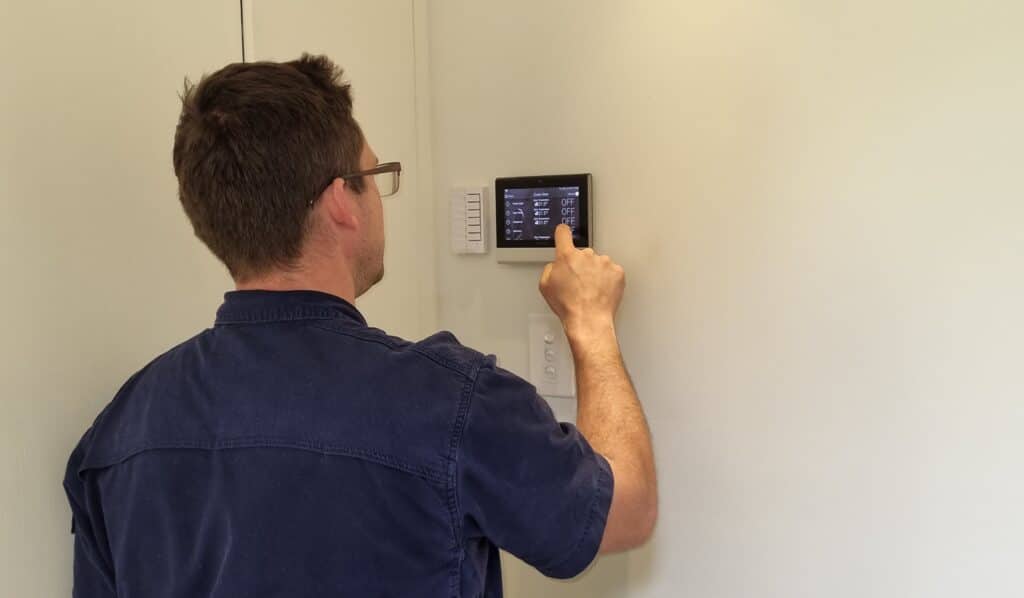
The iQ controller is wall-mounted in a central location, always powered, always accessible, and never lost down the back of the couch. The 8-inch colour touchscreen gives you full visibility of every zone at a glance, and an optional 10-inch tablet is available for larger homes where the extra screen size makes sense.
Remote access from anywhere.
The system connects to your home Wi-Fi, giving you full control from your smartphone. For Logan families where both parents commute toward Brisbane or out to the Gateway Motorway industrial precincts, being able to pre-cool the home before the afternoon school run is a genuinely useful feature, not just a nice extra.
How This Translates to a Real Large Home
Let’s put this in the context of a home we commonly see across Logan’s newer estates. A double-storey, 5-bedroom home with a dedicated theatre room, open plan kitchen and living, a home office, and an alfresco area off the main living space.
A well-designed iQ zoning layout for that home might look like this:
| Zone | Room | Sensor Type |
|---|---|---|
| 1 | Open plan living and kitchen | ITC sensor |
| 2 | Master suite | ITC sensor |
| 3 | Bedroom 2 | ITC sensor |
| 4 | Bedroom 3 | Airflow control |
| 5 | Bedrooms 4 and 5 | Airflow control |
| 6 | Home theatre | ITC sensor |
| 7 | Home office | ITC sensor |
| 8 | Upstairs landing | Airflow control |
Zone layout is indicative. We design each home individually based on floor plan and family usage patterns.
With this setup, a typical evening looks very different to running a non-zoned system.
The living area and kitchen run at full capacity from 4pm. The theatre room is pre-cooled from 6pm ahead of movie night. The bedrooms ramp up from 8pm, with the master suite and kids’ rooms each holding their own set temperature. The home office closes off completely after 5pm.
The whole house is comfortable, and nothing is running unnecessarily.
What About Two-Storey Homes?
Double-storey homes present a specific challenge that zoning addresses particularly well.
Upper floors in Logan’s climate absorb significantly more heat during the day. By mid-afternoon, an unshaded upper floor can be several degrees warmer than downstairs, even with the same AC output going to both levels.
A single thermostat controlling both floors will leave one of them uncomfortable, no matter how you set it.
With Advantage Air iQ, ITC sensors on the upper floor communicate to the system independently. The upper zones automatically receive more airflow to compensate for the higher thermal load. By the time the family heads upstairs for the evening, the upper floor is already at temperature rather than still fighting the residual afternoon heat.
For very large double-storey homes, we sometimes recommend two separate Daikin systems, one per floor, each with its own iQ controller. Both can be linked through the iQ app, so the family manages everything from a single interface.
The Difference Zoning Makes to Running Costs
We’re careful about publishing specific savings figures because every home is different. What we can say is that the combination of inverter technology and intelligent zoning consistently produces lower running costs than fixed-speed or non-zoned systems.
A non-zoned system running on a single thermostat must satisfy the temperature reading at one point in the home, regardless of what’s happening everywhere else. Rooms that are already comfortable keep receiving conditioned air. The system runs longer cycles and draws more power to achieve an outcome that still isn’t consistent.
A properly zoned iQ system runs shorter, more targeted cycles. It directs airflow precisely where it’s needed and reduces output automatically when zones reach their set temperature.
The Daikin inverter compressor responds to that reduced load by slowing down and drawing less power. If you’re also on solar, that reduced draw means more of your generation either offsets the remaining load or exports to the grid.
Under the National Construction Code (NCC) Section J energy efficiency provisions, new residential buildings must demonstrate minimum energy efficiency performance. A well-zoned ducted system with individual temperature control contributes directly to achieving and exceeding those benchmarks.
Common Questions from Logan Homeowners
For most 4-bedroom homes, 6 to 8 zones is the sweet spot. For 5-bedroom-plus homes with dedicated theatre rooms, home offices, or teenager retreats, 8 to 10 zones gives you the flexibility to manage the home properly. We design the zone layout during your site assessment.
In most cases, yes. The Advantage Air iQ platform allows additional zones and sensors to be added after initial installation. ITC sensors can be retrofitted to existing zones where more precise control is needed. It’s always better to plan for more zones upfront, but the system isn’t locked in if your needs change.
No. Temperature sensors add precision where it matters most, typically master suites, home offices, home theatres, and upper-floor bedrooms. Rooms with more consistent thermal loads, hallways and laundries for example, can run on standard airflow control and still perform well.
Yes. Advantage Air iQ is compatible with Google Home and Amazon Alexa for voice control, and with Home Assistant for homeowners who want deeper automation, including linking AC behaviour to occupancy detection or solar generation levels.
All ducted systems we install comply with AS/NZS 1677 (Refrigerating systems) and AS/NZS 5149 (Refrigerating systems and heat pumps — Safety and environmental requirements). Every ClimateLink installation is completed by ARCtick-licensed technicians under the Ozone Protection and Synthetic Greenhouse Gas Management Act 1989 (Cth). Advantage Air iQ components carry a 5-year warranty on electronics and 10 years on ducting and mechanical components.
Our Take
A large home deserves a zoning design that reflects how it actually gets lived in, not a system that treats a 350sqm home the same way it would treat a 120sqm one.
The combination of a correctly sized Daikin inverter ducted system and Advantage Air iQ gives Logan families genuine room-by-room comfort, measurable running cost savings, and the convenience of managing everything from a single tablet on the wall or a phone from anywhere.
If you’re building in one of the new estates around Logan Reserve or Yarrabilba, or retrofitting into an established home in Springwood or Cornubia, we’re happy to come out and design a zoning layout around your floor plan at no cost.
Call us on 1300 224 968 or request a free quote.